All articlesGeneral
From Passwords to Passkeys: The Future of Authentication for Australian Businesses
18 September 20265 min readBy Omnicron Team
From Passwords to Passkeys: The Future of Authentication for Australian Businesses

Authentication is undergoing its most significant structural shift in decades. For years, passwords have served as the primary gateway to corporate networks, financial accounts, and customer databases. Today, they represent the single largest vulnerability in enterprise security. As cyber threats evolve, Victorian organisations must transition from legacy credentials to modern, phishing-resistant mechanisms. Passkeys offer the definitive path forward, establishing robust security without sacrificing operational efficiency.
Effective cybersecurity for small business Australia requires moving beyond reactive measures. Implementing advanced authentication standards is no longer optional for businesses handling sensitive data. Through our specialized managed IT services Melbourne and comprehensive frameworks, Omnicron helps local enterprises navigate this technological transition safely and efficiently.
Passwords were built for an era of simple computing, not modern distributed networks and automated cybercrime. They fail for three primary reasons:
Credential Stuffing and Reuse: Employees frequently reuse identical passwords across personal and corporate platforms. When a third-party service suffers a data breach, cybercriminals automatically test those credentials against business portals, corporate email accounts, and cloud storage providers.
Advanced Phishing Attacks: Modern phishing campaigns deploy AI-generated replicas of login portals, capturing user credentials and One-Time Passwords (OTPs) in real time. Standard multi-factor authentication (MFA): such as SMS codes: remains vulnerable to interception and adversary-in-the-middle attacks.
Human Error: Complex password policies often result in predictable user behavior, including writing credentials on sticky notes or choosing easily guessable strings.
Reliance on legacy passwords directly compromises cyber threat protection for SMEs, leaving operations exposed to unauthorized access and ransomware deployment.
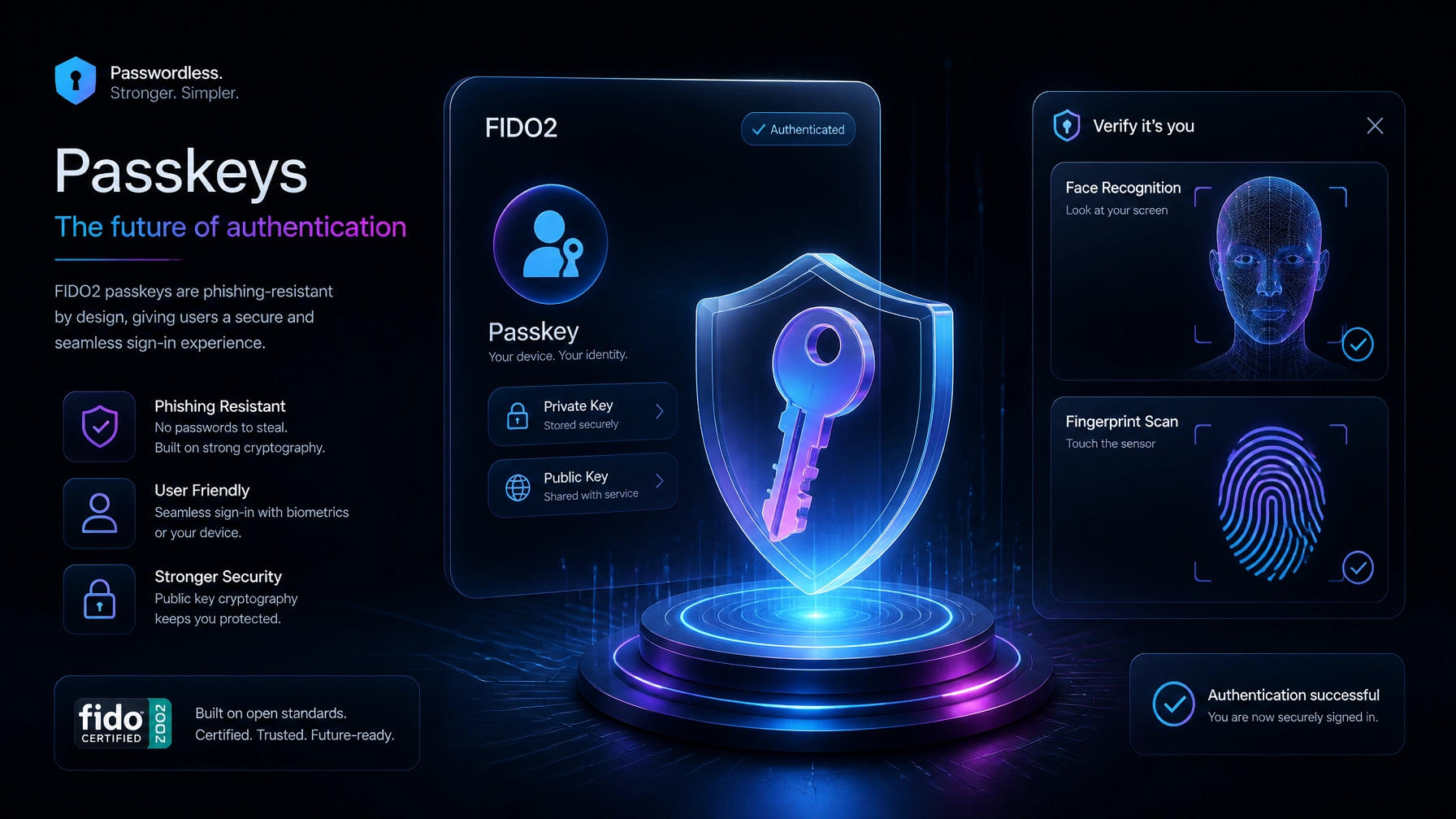
Passkeys replace traditional passwords with cryptographic key pairs built on open standards defined by the FIDO Alliance and the World Wide Web Consortium (W3C), known as FIDO2 and WebAuthn.
A passkey is bound directly to a user's trusted device: such as a smartphone, laptop, or hardware security key: and protected by local biometrics (fingerprint or facial recognition) or a secure PIN.
Key attributes of passkeys include:
Phishing Resistance: Passkeys operate only on legitimate domains. Even if a user visits a fraudulent phishing site, the browser or device refuses to release the credential.
No Shared Secrets: No password travels across the network or sits on a remote corporate database where it can be intercepted or stolen.
Zero Memorisation Required: Users authenticate instantly using biometric verification, eliminating friction while elevating security.
Understanding passkeys requires examining public-key cryptography. When a user registers a passkey with a web service or application, two distinct cryptographic keys are generated:
The Public Key: Sent to and stored on the service provider's server. It has zero value to an attacker if intercepted.
The Private Key: Stored securely within the hardware secure enclave of the user's local device (such as Apple's Secure Enclave, Android's Keystore, or a dedicated FIDO2 USB hardware token). It never leaves the device.
When logging in, the server issues a cryptographic challenge. The user's device signs this challenge using the private key, verified instantly by the server's public key. Authentication succeeds without any secret password ever crossing the network.
The Australian Cyber Security Centre (ACSC) provides clear benchmarks for modern authentication through the Essential Eight maturity model. According to guidance published on cyber.gov.au, organisations must progressively adopt phishing-resistant multi-factor authentication to protect sensitive systems and administrative accounts.
ACSC guidelines emphasise that legacy MFA methods (such as SMS text messages and email-based OTPs) are increasingly inadequate against sophisticated threat actors. To achieve higher maturity levels under the Essential Eight framework, businesses must deploy cryptographically secure, device-bound authentication methods, including FIDO2 security keys, Windows Hello for Business, and device-bound passkeys.
Adoption across global technology ecosystems is nearly universal. Major enterprise and consumer platforms fully support passkeys natively:
Apple: Integrated across iOS, iPadOS, and macOS via iCloud Keychain.
Google: Supported natively on Android and ChromeOS, with synchronization via Google Password Manager.
Microsoft: Fully integrated into Windows 11, Entra ID (formerly Azure AD), and Microsoft Authenticator.
For Australian small and medium-sized businesses, this widespread native support removes deployment friction. Users can generate, store, and utilize passkeys across their daily work tools without requiring complex third-party software installations.

Migrating an entire enterprise away from passwords requires a structured, phased methodology:
Audit Existing Identity Infrastructure: Identify all cloud applications, internal portals, and customer databases currently reliant on legacy passwords.
Deploy Passkey-Compatible MFA: Enable platform authenticators and evaluate hardware FIDO2 security keys for high-privileged accounts and administrative personnel.
Establish Secure Recovery Procedures: Ensure robust backup verification workflows (such as administrative temporary access passes or secondary registered devices) are in place to handle lost or replaced hardware.
Educate Staff: Conduct internal training sessions highlighting the operational benefits of passwordless authentication and how biometrics protect company data.
Transitioning to modern authentication standards requires technical precision and strategic oversight. Omnicron provides end-to-end guidance for Victorian businesses looking to secure their digital environments.
Our team specializes in designing resilient identity architectures that integrate seamlessly with your existing operations. Through our structured service roadmap: from initial security reviews to ongoing managed protection: we help you implement robust MFA, FIDO2 standards, and continuous monitoring via our OmniShield Live Defence system.

Passwords are a legacy vulnerability that Victorian businesses can no longer afford to maintain. Passkeys provide an immediate, foolproof defense against credential stuffing and phishing attacks while streamlining daily user workflows.
Protect your business infrastructure, meet ACSC compliance benchmarks, and eliminate password-related downtime with professional guidance from Omnicron.
Ready to transition to secure, passwordless authentication? Contact our team today or explore our Security Review services to evaluate your current IT resilience.

Book a free security check and we'll show you where your business stands clear next steps, no jargon, no obligation.
Or explore our free security tools — 30+ scanners, checkers and assessments, free with an account.