All articlesGeneral
ACSC Essential Eight in 2026: What Victorian Businesses Need to Know
29 July 20265 min readBy Omnicron Team
ACSC Essential Eight in 2026: What Victorian Businesses Need to Know

For Victorian small and medium-sized businesses (SMBs), navigating the cyber threat landscape requires clear, authoritative frameworks. The Australian Signals Directorate (ASD) and the Australian Cyber Security Centre (ACSC) have long maintained the Essential Eight as the gold standard for mitigating cyber security incidents.
Even with the ASD announcing a planned 24-month transition toward a modular Essentials series: starting with Essentials for enterprise IT: the fundamental security principles remain vital. For businesses seeking reliable cybersecurity services Victoria wide, understanding how these standards apply to your operations is essential for maintaining compliance, securing cyber insurance, and protecting sensitive data.
You can review the official guidance directly through the ACSC cyber.gov.au portal. Below is a comprehensive breakdown of what Victorian organisations need to know about the Essential Eight in 2026 and how to position your business for operational resilience.
In mid-2026, the ASD confirmed a phased rollout for a new, modular Essentials series designed to supersede the single Essential Eight framework over the next two years. The first draft chapter, Essentials for enterprise IT, introduces an outcomes-based, threat-informed approach to replace prescriptive controls.
However, business leaders must note a critical operational reality: The Essential Eight remains fully active and recognised during this transition period.

Regulatory bodies, cyber insurers, and government procurement panels continue to evaluate organisations against the Essential Eight. Investments made today under this framework are fully recognized under the evolving ASD standards. Abandoning your security posture while waiting for the new framework is a critical risk. Instead, treat the Essential Eight as your immediate baseline while monitoring the transition to the broader Essentials series.
The Essential Eight uses a maturity model ranging from Maturity Level 0 (ML0) to Maturity Level 3 (ML3). For most Victorian SMBs across sectors such as legal, medical, financial services, and manufacturing, understanding these levels dictates your ability to win contracts and secure insurance coverage:
Maturity Level 1 (ML1): The baseline requirement for standard SMB operations. It addresses targeted cyber attacks that use common tools and commodity malware.
Maturity Level 2 (ML2): Increasingly demanded by cyber insurance underwriters and federal procurement panels. It requires more robust enforcement, formal policies, and consistent technical controls.
Maturity Level 3 (ML3): Tailored for organisations facing advanced, persistent threat (APT) actors with significant resources.
A common misconception is that achieving high scores in a few areas offsets weaknesses elsewhere. In the Essential Eight framework, all eight mitigation strategies must reach the same maturity level. Your overall rating is determined entirely by your lowest-scoring control. If seven strategies are at ML2 but application patching sits at ML0, your enterprise rating remains ML0.
Implementing the Essential Eight requires a systematic technical approach across your IT environment. Here are the eight core mitigation strategies:
Application Control: Restricting unauthorized software execution to prevent malicious code from running on workstations and servers.
Patch Applications: Updating software, operating systems, and firmware promptly to remediate known vulnerabilities.
Configure Office Macros: Blocking untrusted macros in Microsoft Office applications and disabling execution from the internet.
User Application Hardening: Disabling unneeded browser features (like Flash or Java) and configuring secure default web settings.
Restrict Administrative Privileges: Limiting high-level access rights based on user duties and conducting regular reviews of privileged accounts.
Patch Operating Systems: Applying security updates and patches to server and workstation operating systems within regular timeframes.
Multi-Factor Authentication (MFA): Enforcing robust MFA across remote access, cloud services, and privileged accounts to prevent credential compromise.
Regular Backups: Maintaining daily, immutable, and offline backups of critical business data, tested regularly for restoration reliability.
In 2026, cyber insurance providers and enterprise supply chains no longer accept tick-box self-assessments. When renewing policies or bidding for government and corporate contracts, organisations must provide verifiable, evidence-based proof of their security posture.

Self-reporting a high security maturity without technical validation exposes businesses to rejected insurance claims following a breach. Insurers now audit endpoints, examine active directory configurations, and verify backup logs. Achieving true compliance requires continuous, automated monitoring and independent technical validation.
Navigating the complexities of the Essential Eight and preparing for future ASD standards requires dedicated technical expertise. As a leading provider of managed IT services Melbourne businesses trust, Omnicron delivers structured pathways to robust security.
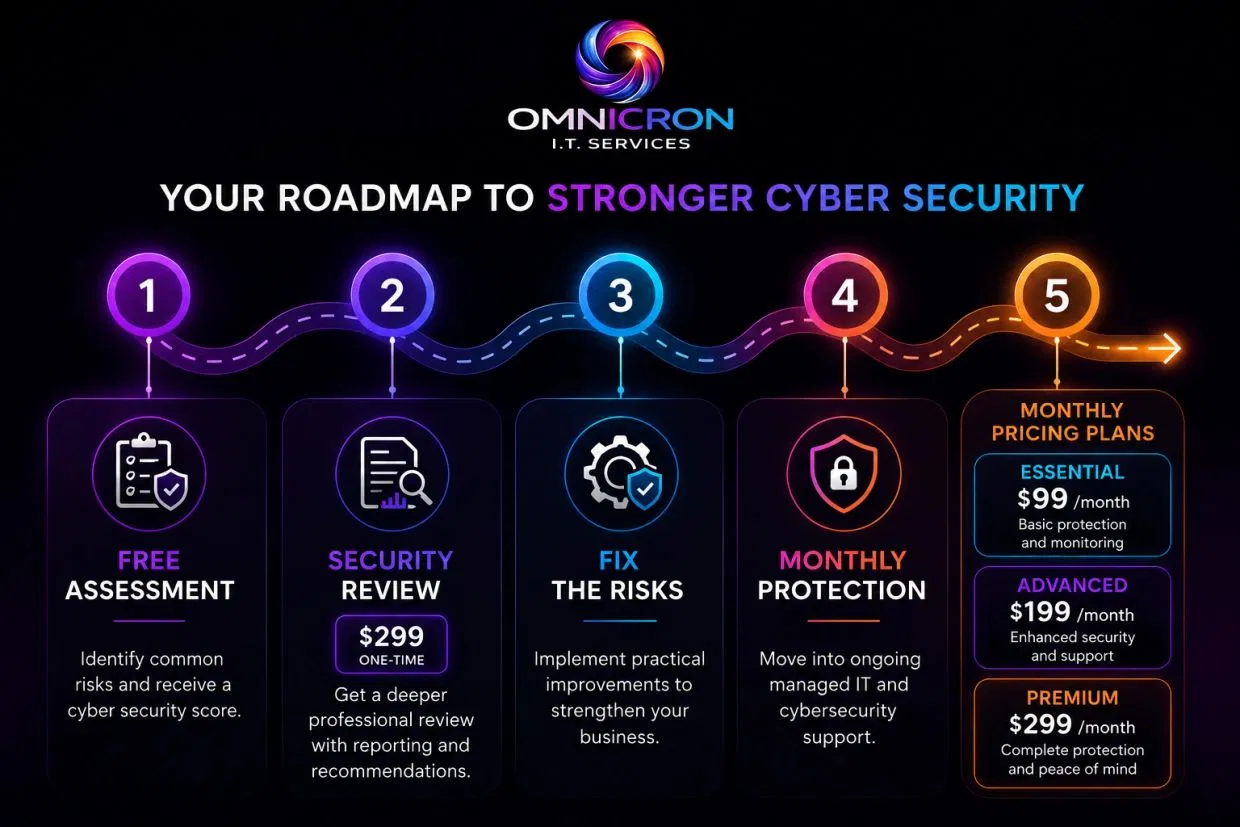
We remove the guesswork from compliance through our dedicated Security Review ($299). This comprehensive baseline assessment evaluates your current IT environment against established benchmarks, identifying vulnerabilities before attackers can exploit them.

Free Risk Assessment: An initial evaluation of your high-level exposure.
Professional Security Review ($299): Deep-dive analysis with clear, actionable reporting.
Remediation: Fixing identified gaps and aligning controls to Essential Eight baselines.
Managed Protection: Continuous, real-time monitoring via our OmniShield Live Defence system.
Tiered Managed Plans: Scalable monthly support: Essential ($99), Advanced ($199), and Premium ($299): tailored to your organisation's size and compliance requirements.
Whether you require specialised IT consulting Melbourne or comprehensive ongoing support, our local, Australian-based team ensures your business remains secure, compliant, and operational.
The transition toward the ASD Essentials series highlights one fundamental truth: cyber security is an ongoing, continuous operational requirement. Maintaining alignment with the Essential Eight safeguards your revenue, protects sensitive client data, and satisfies modern insurance mandates.

Take the proactive step today. Review official guidelines at cyber.gov.au to understand regulatory expectations, then partner with Omnicron to verify your defences.
Contact Omnicron today to book your $299 Security Review and secure a resilient future for your Victorian business.
Book a free security check and we'll show you where your business stands clear next steps, no jargon, no obligation.
If you are unable to reach us by phone, please email and a member of our team will respond promptly.
Or explore our free security tools — 30+ scanners, checkers and assessments, free with an account.