All articlesGeneral
ACSC AI Security Guidance: How Small Businesses Can Use AI Safely in 2026
1 August 20265 min readBy Omnicron Team
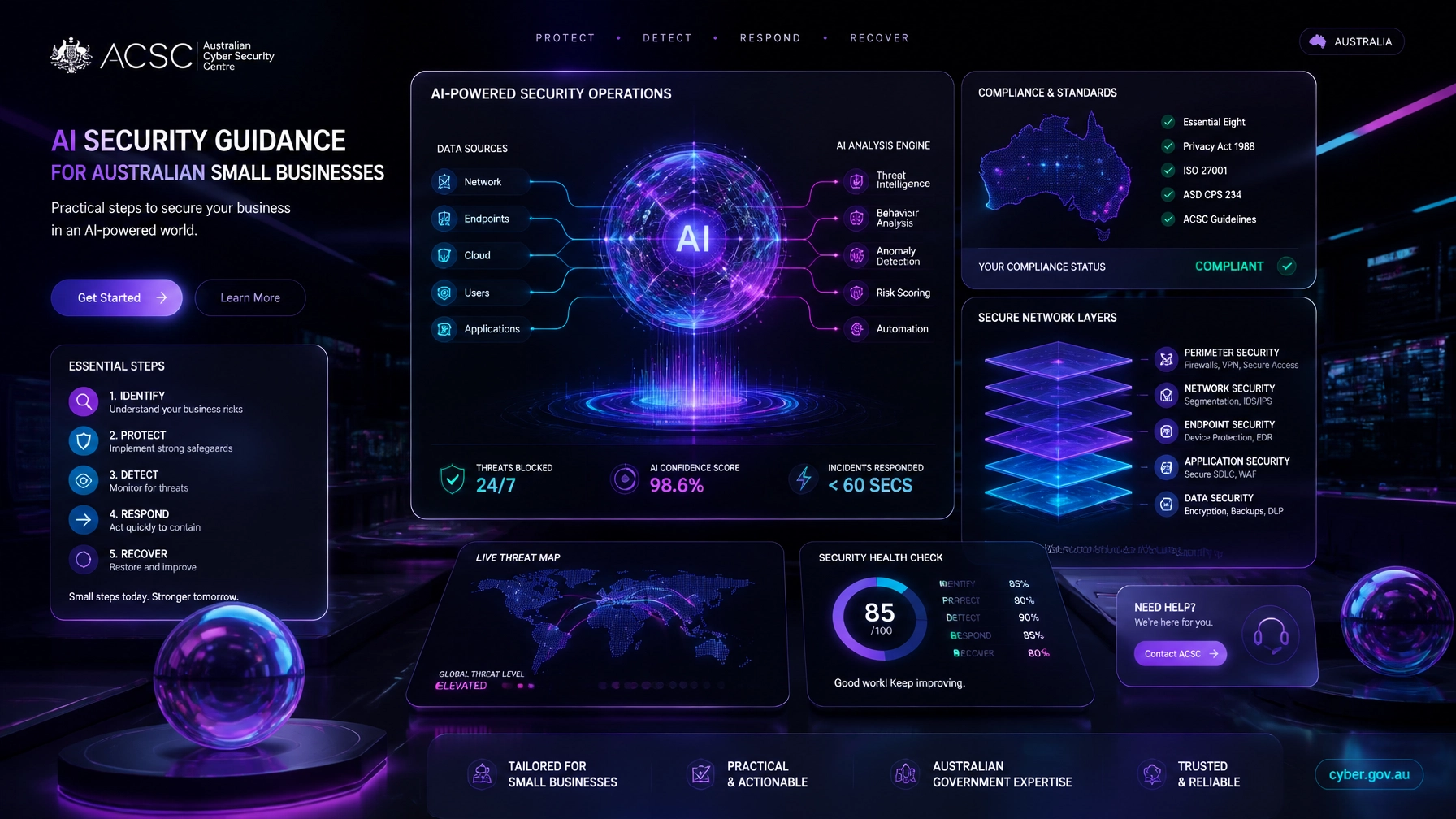
ACSC AI Security Guidance: How Small Businesses Can Use AI Safely in 2026

The rapid adoption of artificial intelligence tools across Victorian small and medium-sized businesses (SMBs) has transformed daily operations. From automated client intake for law firms to predictive analytics in manufacturing and clinical scheduling in medical practices, generative AI and cloud-based copilots offer undeniable efficiency gains. However, this technological leap introduces significant cyber security exposures.
To address these emerging threats, the Australian Signals Directorate’s Australian Cyber Security Centre (ACSC) released updated guidance detailing how organisations can harness AI innovation without compromising operational resilience. For businesses seeking reliable cybersecurity for small business Australia, understanding and implementing these security frameworks is mandatory.
Omnicron provides specialized managed IT services Melbourne and strategic IT consulting Melbourne to help local enterprises navigate these standards, secure their digital infrastructure, and deploy enterprise-grade AI safely.
According to ACSC advisory frameworks available via cyber.gov.au, small businesses frequently underestimate the attack surface introduced by unmanaged AI applications. Integrating cloud-based AI tools without adequate governance exposes organisations to three critical categories of risk:
Standard consumer AI platforms often capture, store, and utilize user input data to retrain their underlying models. When staff members paste sensitive client information, financial records, proprietary trade secrets, or patient health data into public AI chat interfaces, that data leaves the organisation's legal boundary. This constitutes an immediate breach of privacy regulations, professional confidentiality obligations, and internal data governance standards.

AI models are statistical predictors, not infallible authorities. They are susceptible to "hallucinations": generating plausible-sounding but entirely fabricated facts, citations, or figures. Furthermore, malicious actors can execute prompt injection attacks, embedding hidden instructions within web pages or incoming emails that manipulate AI systems into performing unauthorized actions or leaking hidden system data. Relying on unverified AI outputs for high-stakes financial, legal, or medical decisions creates unacceptable business liability.
Most SMBs do not build their own AI models; they consume them as third-party SaaS services. Your organisation’s security posture is inherently tied to the security practices of your AI vendors. If a third-party AI provider experiences a credential compromise, inadequate data segregation, or a supply chain breach, your business data is directly exposed. Evaluating vendor reliability and compliance standards is a critical component of robust IT governance.
To counteract these vulnerabilities, the ACSC outlines actionable mitigation strategies that organisations must embed into their daily operations.
Every business leveraging AI must institute a clear, written Acceptable Use Policy. This policy must explicitly define:
Which AI tools are approved for business use.
Which categories of data (e.g., Personally Identifiable Information, client financial records, IP) are strictly prohibited from being entered into AI interfaces.
The disciplinary and technical consequences of unauthorized "Shadow AI" usage.
Before any text or data is submitted to a cloud-based AI service, staff must strip out all sensitive identifiers, commercial secrets, and personal metadata. Standard operating procedures should mandate synthetic data replacement where real-world specifics are unnecessary for the task.

High-stakes decisions: such as legal filings, clinical recommendations, financial reporting, or contractual commitments: must never be delegated fully to automated systems. Organisations must establish mandatory human oversight protocols to verify, fact-check, and validate all AI-generated outputs prior to execution or distribution.
Before subscribing to any AI platform, businesses must audit the vendor’s security documentation. Key verification criteria include:
Clear data ownership terms confirming that your business retains exclusive rights to input and output data.
Explicit opt-out commitments guaranteeing your data is not used for model training.
Independent security credentials, such as ISO 27001 certification or alignment with the NIST AI Risk Management Framework.
Transparent incident notification procedures outlining how vulnerabilities and breaches are reported to customers and regulatory bodies like the ACSC.
Navigating regulatory compliance and technical risk mitigation requires specialized expertise. Omnicron delivers a structured, security-first approach to managed technology, ensuring your business benefits from modern AI capabilities without exposing itself to avoidable cyber threats.
Through our comprehensive Security Review, our local Victorian engineers audit your network environment to detect unauthorized AI applications ("Shadow AI") currently in use by employees. We identify hidden data exposure points and deliver an actionable risk report.
We help businesses transition away from consumer-grade AI platforms that harvest input data. By deploying enterprise-grade environments such as Microsoft Copilot for M365 and ChatGPT Team, we ensure that your corporate data remains strictly encrypted, protected by enterprise privacy boundaries, and isolated from public model training sets.

Security is an ongoing operational requirement, not a one-time project. Omnicron’s Managed Protection services provide continuous, real-time monitoring of your IT infrastructure. Powered by our OmniShield Live Defence system, we deliver clear visibility into threat detection, encryption status, and system uptime.
Whether you operate a medical clinic in Geelong, a law firm in Melbourne CBD, or a manufacturing enterprise in regional Victoria, our Australian-based support team ensures your business remains resilient, compliant, and secure.
Integrating AI safely requires balancing operational innovation with rigorous risk management. By aligning your internal practices with official ACSC guidelines published on cyber.gov.au, you protect your clients, your reputation, and your bottom line.

Protect your business from data leaks, compliance failures, and technical downtime. Contact Omnicron today to schedule your professional Security Review and discover how our managed IT services can secure your digital future.
Website: www.omnicron.com.au
Services: Managed IT Services | Security Review
Contact: Get in touch with our team
Book a free security check and we'll show you where your business stands clear next steps, no jargon, no obligation.
Or explore our free security tools — 30+ scanners, checkers and assessments, free with an account.